CPT Modifiers in Mental Health Billing
TherapyAppointment • Published on June 17, 2026

Key Takeaways
- A CPT modifier tells a payer how a service was delivered without changing what the service was.
- For telehealth: 95 for live audio and video, 93 for audio only, with FQ and GT wanted by certain payers.
- 59 marks genuinely distinct same day services. 25 marks a separate evaluation and management service.
- HJ identifies EAP funded sessions.
- 90785, interactive complexity, is an add on code rather than a modifier, which is a common mix up.
- A missing or wrong modifier is one of the most common reasons a mental health claim denies.
A modifier is a two-character code added to a CPT code on an insurance claim. It gives the payer one more piece of information, such as whether a session happened by video or whether two services on the same day were truly separate.
Most therapists use only a few modifiers regularly. This guide covers the modifiers therapists are most likely to run into, when they may be needed and what to check before submitting a claim. Payer rules vary, so always confirm the current requirements for the client's plan.
The short version
• 95 is commonly used for a live video session.
• 93 is commonly used for a live audio-only session.
• FQ and GT still appear in specific Medicare, Medicaid and commercial payer rules.
• 59 may be used when two same-day services were genuinely separate and the payer allows it.
• 25 applies to certain separate evaluation and management services.
• HJ identifies an employee assistance program service when the payer requires it.
One important distinction: 90785 for interactive complexity is an add-on CPT code. It is not a modifier and gets its own line on the claim.
There is no single modifier rule for every therapy claim. The right modifier depends on the service, the payer and, in some cases, the client's location.
What is a CPT modifier
The CPT code tells the payer what service you provided. The modifier adds context about how or under what circumstances you provided it.
For example, 90834 still identifies a 45-minute psychotherapy session whether it happened in the office or by video. If the visit was virtual, the modifier tells the payer that. The place of service code, or POS, separately tells the payer where the client was during the session.
What CPT modifier do you use for telehealth therapy
For most live video sessions, modifier 95 is the modifier you're most likely to see. Use it for a session delivered with two-way audio and video when the payer requires it.
Modifier 93. Use this for a live audio-only session when the payer covers audio-only care and accepts this modifier.
Modifier FQ. This is another audio-only modifier used in specific payer and Medicare settings. For Medicare FQHC mental health visits, CMS allows FQ or 93 for audio-only services. Outside that setting, check the payer's instructions. Do not assume FQ and 93 are interchangeable or put both on the claim unless the payer tells you to.
Modifier GT. This older video modifier is no longer required on Medicare professional claims, but some Medicaid programs, Blues plans and institutional claims still use it. If a claim with 95 rejects, check the payer's billing guidance before switching to GT.
Modifier FR. This indicates that a supervising practitioner was present through real-time audio and video. It applies to specific supervision situations, not telehealth visits in general.
Which place of service code goes with telehealth
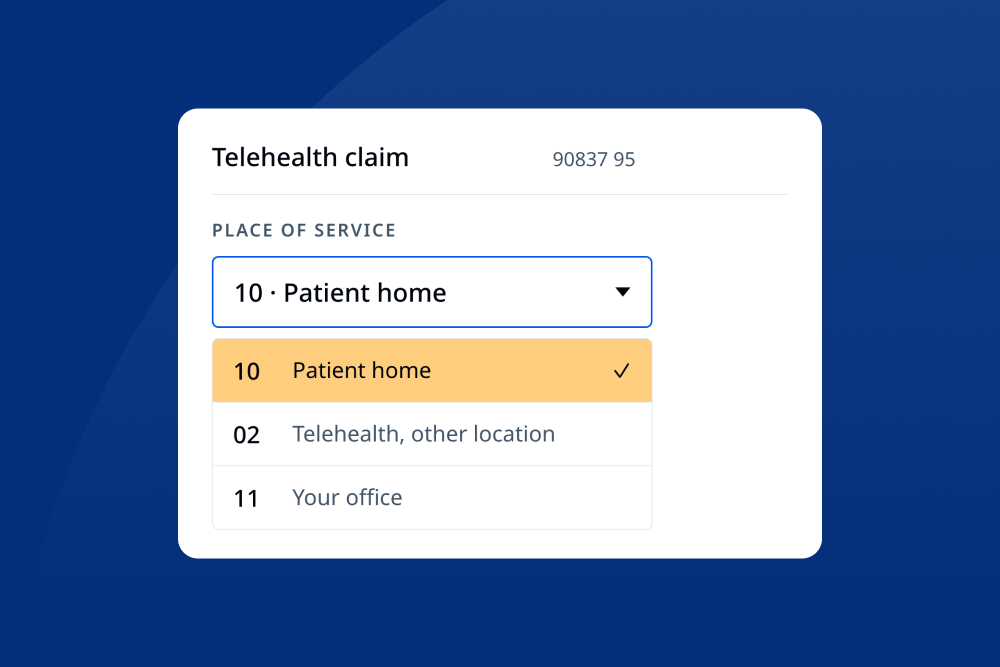
A telehealth modifier and a POS code work together. For Medicare, POS 10 means the client was at home and is paid at the non-facility rate. POS 02 means the client was somewhere other than home and uses the facility rate. Medicaid and commercial payer rules can differ.
The POS generally describes the client's location, not the clinician's. The temporary Medicare practice of billing POS 11 with modifier 95 ended after 2023. Some commercial plans still accept that combination, so check the payer before using it.
Medicare also has separate rules about in-person care connected to mental health telehealth. As of 2026, those requirements are delayed through December 31, 2027. Because the timeline has changed more than once, verify the current CMS rule before billing a Medicare telehealth service.
When should therapists use modifier 59
Some code pairs are normally bundled, which means the payer treats one service as part of the other. Modifier 59 may allow both services to be reported when they are genuinely distinct. It is not a general fix for a bundled denial.
Situations where modifier 59 may come up include:
• Group psychotherapy and individual psychotherapy provided at different times on the same day.
• Family therapy and an individual session provided to the same client on the same day.
• Psychological testing services provided alongside an evaluation.
None of these examples automatically supports modifier 59. First check the current NCCI Procedure-to-Procedure edit and the payer's policy. The edit must allow a modifier, and the documentation must show why the services were separate.
If modifier 59 is allowed, add it to the Column 2 code listed in the NCCI edit table. The code that is denied is not always the line that should carry the modifier.
What are XE XP XS and XU
CMS also created four more specific modifiers: XE for a separate encounter, XP for a separate practitioner, XS for a separate anatomic structure and XU for an unusual non-overlapping service. In mental health billing, XE is the one most likely to apply when the record supports two separate encounters. Some payers require an X modifier instead of 59. Do not use 59 and an X modifier to describe the same circumstance.
Before using modifier 59
• Confirm that the code pair has a current edit.
• Confirm that the edit and the payer allow a modifier.
• Document separate start and stop times, notes and clinical purposes when applicable.
• Make sure the payer allows both services on the same day.
When is modifier 25 used with psychotherapy
Modifier 25 comes into play when you provide a separate E/M service on the same day as another billable procedure. It is most relevant to clinicians who bill E/M codes.
When an E/M visit and psychotherapy happen during the same encounter, use the appropriate psychotherapy add-on code: 90833, 90836 or 90838. Bill it with the E/M code, such as 99213. Some payers also require modifier 25 on the E/M line, so check the payer's policy before submitting the claim.
HJ and other payer specific modifiers
HJ. This identifies a service funded through an employee assistance program when the payer requires it. Missing HJ can cause the claim to process under the wrong benefit or deny.
Medicaid programs may also require modifiers that describe the clinician or program:
• HO Master's degree level
• HN Bachelor's degree level
• HP Doctoral level
• AJ Clinical social worker
• AH Clinical psychologist
• HQ Group setting
• HF Substance use program
• U1 through UD State-defined modifiers whose meaning comes from that state's provider manual
These requirements vary by state and plan. Use the definition in the payer's current provider manual rather than assuming a modifier means the same thing everywhere.
Is 90785 a modifier
CPT code 90785 describes interactive complexity. It may apply when specific communication factors make a psychiatric service more difficult to deliver. Examples can include managing difficult communication among family members, addressing a report to a court or child protective agency during the service, or using play equipment to overcome a communication barrier.
Using an interpreter does not qualify on its own. The note must identify the specific communication factor that supports the code.
A few rules to remember:
• Bill 90785 on its own claim line with a primary service. Never place it in a modifier field.
• It may be reported with eligible psychiatric diagnostic, psychotherapy and group psychotherapy codes.
• Do not report it with crisis psychotherapy or family therapy codes.
• Check the current CPT instructions and payer policy before billing it.
Payment varies by year, location and payer. Use the code only when the service meets the criteria and the documentation supports it.
What do modifier related claim denials mean
These claim adjustment reason codes often appear with modifier problems:
• CARC 4. The modifier does not fit the procedure code, or a required modifier is missing.
• CARC 97. The payer considers the service part of another service that was already processed.
• CARC 16. The claim is missing information or contains a billing error. Check the related remark code for details.
Before correcting the claim, compare the modifier, CPT code and POS with the payer's current instructions. A rejected claim does not tell you which replacement modifier to use. Guessing can lead to another denial and delay payment by weeks.
Make yourself a payer modifier cheat sheet
Make a simple cheat sheet for the plans you bill most often. For each payer, record the video modifier, audio-only modifier, accepted POS codes, license-level modifier, EAP modifier and whether the payer accepts 59 or requires an X modifier. Use the payer's provider manual and your paid remittances to keep it current.
How TherapyAppointment handles modifiers
If you use TherapyAppointment, you can set default modifiers by payer so you do not have to remember the same billing rule every time you create a claim. Free ERA processing also posts remittances automatically, so you can see the payer's denial or adjustment reason when something comes back.
A note on CPT and payer policy
CPT copyright American Medical Association. All rights reserved. CPT is a registered trademark of the AMA. The descriptions in this article are written in our own words and are not official code descriptors. Coverage rules, modifier requirements and payment amounts vary by payer, plan, state and calendar year. Verify your contracts and current payer manuals before billing.
Codes referenced: CPT 90785, 90791, 90792, 90832, 90833, 90834, 90836, 90837, 90838, 90839, 90840, 90846, 90847, 90853, 96130, 96136 and 99213; modifiers 95, 93, 59, 25, GT, FQ, FR, XE, XP, XS, XU, HJ, HO, HN, HP, AJ, AH, HQ, HF and U1 through UD; POS 02, 10 and 11; CARC 4, 16 and 97.
Crucial questions – addressed.
What is the most common modifier for telehealth therapy?
Modifier 95 is commonly used for live audio-and-video telehealth sessions, but payer requirements vary.
What modifier is used for audio only therapy?
Modifier 93 is commonly used for live audio-only sessions. Some Medicare and payer-specific situations use FQ instead.
Is 90785 a modifier?
No. CPT 90785 is an add-on code for interactive complexity and is billed on its own claim line.
Can I use modifier 59 if two therapy services happen on the same day?
Sometimes, but only when the services are genuinely separate and the payer and applicable NCCI edit allow it.
Can TherapyAppointment add modifiers automatically?
Yes. You can set default modifiers by payer so they are added when the claim is created.