Superbills for Therapists: What to Include and How Clients Get Reimbursed
Key Takeaways
- A superbill is an itemized receipt you give the client. They submit it to their insurer; you do not.
- It must carry your NPI and tax ID, the client's details, dates of service, CPT codes, an ICD-10 diagnosis, and what was charged and paid.
- A diagnosis code is not optional.
- A superbill is not a Good Faith Estimate. The two serve different purposes.
- Reimbursement depends on the client's out of network benefits and deductible, so it is worth them calling their plan before the first session.
Reviewed as of September 2026
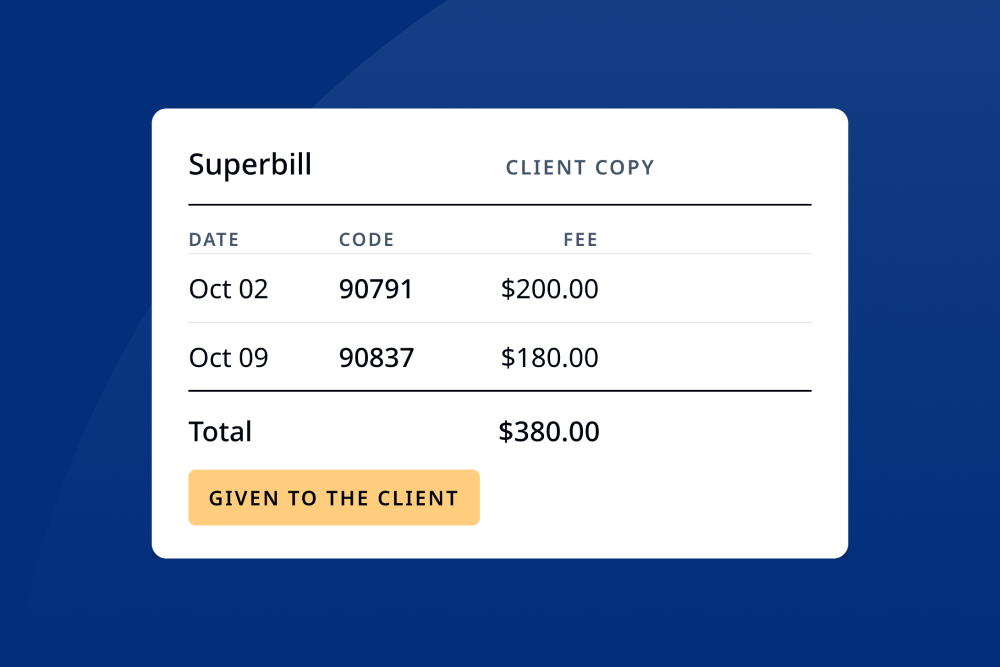
A superbill is an itemized receipt you give a client so they can request out-of-network reimbursement from their insurer. You don't send it to the payer. The client does. To be usable it needs your NPI and tax ID, the client's details, dates of service, CPT codes, an ICD-10 diagnosis, and what was charged and paid.
What a superbill actually is
Three parties touch a superbill and each has one job. You produce it. The client submits it. The insurer reimburses the client directly at whatever their out-of-network benefit allows. Money never moves through your practice, because you were already paid in full at the time of service.
That is the entire mechanism. Everything else is making sure the document carries enough information for a claims processor who has never heard of you to open a file, match a member to a policy, price the service, and issue a payment.
Superbill vs. claim vs. receipt
These three documents are often used interchangeably in conversation, but they serve different purposes and are not interchangeable.
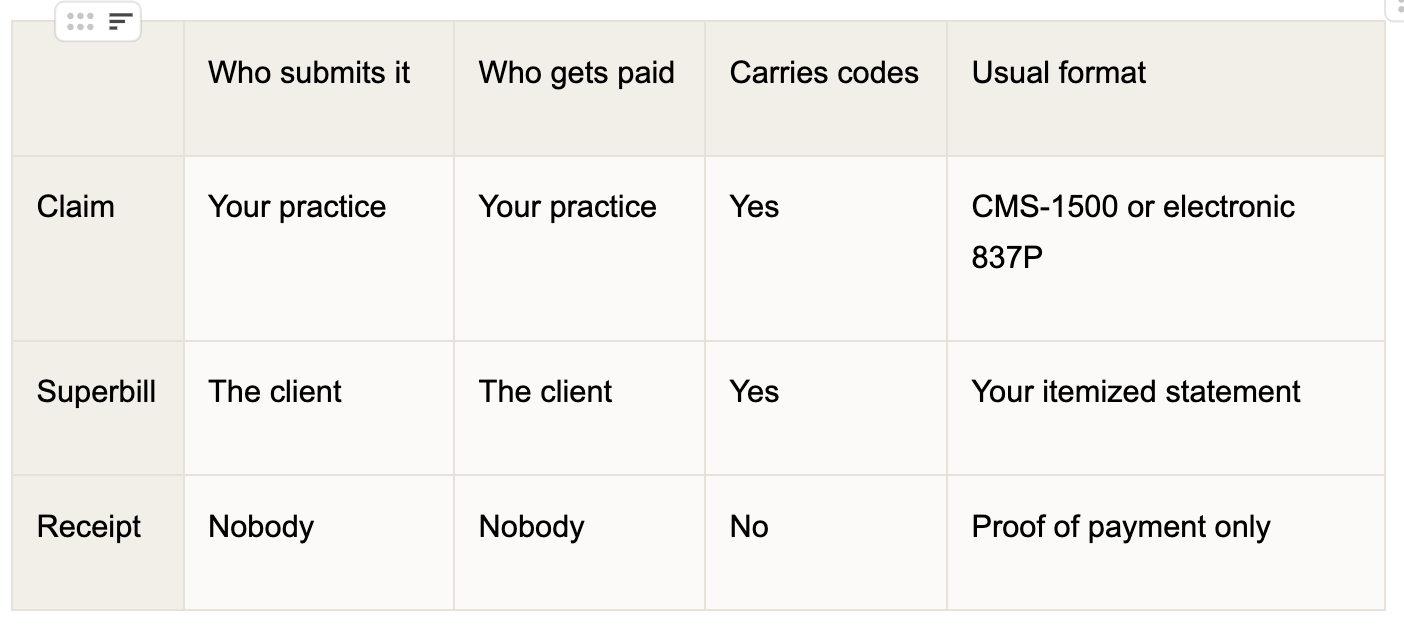
A claim is a request for payment or reimbursement submitted to a health plan for services provided. Depending on the situation, it may be submitted by the provider or by the client.
A superbill is a detailed, coded document you give to a client so they can submit their own claim for possible out-of-network reimbursement. It includes the clinical and billing information the health plan typically needs to evaluate the claim.
A receipt, on the other hand, primarily documents payment. By itself, it generally doesn't contain enough information for an insurer to process a reimbursement claim because it may not identify the service provided, the diagnosis, or other required claim information.
One more distinction worth keeping straight: a superbill isn't a Good Faith Estimate. A Good Faith Estimate is forward-looking—it describes the expected cost of anticipated services. A superbill is backward-looking—it documents services that have already been provided and the associated charges and payments.
What a superbill must contain
Missing fields are the single most common reason a client's reimbursement request stalls. Build a template once and every field is handled forever.
Provider information
- Your legal name and credentials, for example LCSW, LMFT, LPC, PsyD, or PhD
- License type, number, and state of licensure
- Your individual NPI (Type 1), plus the group NPI (Type 2) if you bill under a group
- Tax ID. An EIN is strongly preferred over your Social Security number, since this document travels through a client's hands, a mail room, and a claims queue. An EIN is free to obtain, and the case for an EIN over your SSN goes beyond superbills.
- Practice name, physical street address, and phone number. A PO box gets superbills kicked back by some plans.
Client information
- Full legal name exactly as it appears on the insurance card
- Date of birth and mailing address
- Member ID and group number (if required by payor)
Service lines, one row per session
- Date of service
- Place of service code
- CPT code and number of units
- Any applicable modifier
- Charge for that line
- Amount the client paid and the date they paid it
Diagnosis
- At least one ICD-10 code, linked to the service lines
Totals
- Total charged, total paid, and balance due
That last line matters more than people expect. Most plans reimburse the client for what the client actually paid. If your superbill shows $180 charged and $0 paid with a balance outstanding, the plan can and often will deny it. Issue superbills only for sessions that are paid in full, and show the balance as $0.00.
The CPT codes on most therapy superbills
These are the codes that cover the large majority of outpatient mental health sessions. Descriptions below are written in plain language, not the official code descriptors.
- 90791 The intake session: gathering history, assessing presenting concerns, and establishing a diagnosis and initial treatment plan, without a medical exam or other medical service.
- 90792 An intake session covering the same ground as 90791, plus a medical component such as a physical exam, ordering labs, or prescribing, performed by a prescriber.
- 90832 Individual psychotherapy at the short length, generally documented at 16 to 37 minutes.
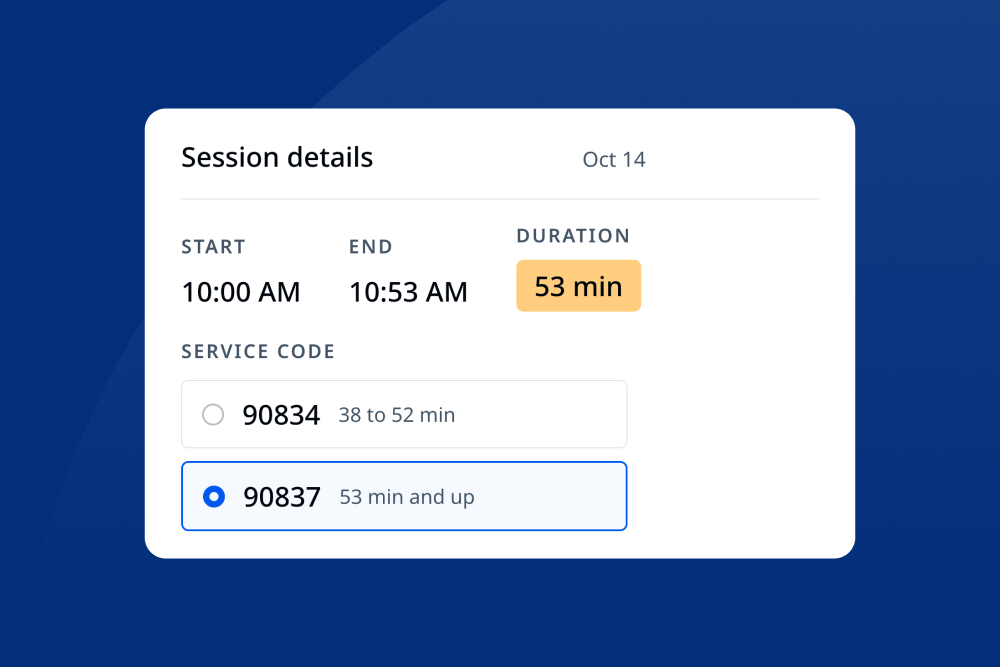
- 90834 Individual psychotherapy at the standard length, generally 38 to 52 minutes. This has long been the workhorse code in outpatient therapy.
- 90837 Individual psychotherapy at the extended length, 53 minutes or more.
- 90846 Family therapy conducted without the identified client in the room.It has a typical time of 50 minutes. Unlike the individual psychotherapy codes, it doesn't have a CPT-defined time range, and payers differ on whether a midpoint rule applies, so confirm before billing a shorter session.
- 90847 Family or couples therapy with the identified client present. Same typical 50-minute time as 90846, and the same payer-dependent handling of shorter sessions.
- 90853 Psychotherapy delivered to a group of clients who are not related to each other, billed per member per session. It doesn't cover multiple-family group psychotherapy, which is reported under a separate code.
- 90785 Add-on for interactive complexity, reportable when the session itself is harder to conduct: for example, the need to manage maladaptive communication among the people in the room (high anxiety, high reactivity, repeated questions, or disagreement) that complicates delivering care, a caregiver whose own distress or behavior interferes with carrying out the treatment plan, a mandated report of suspected abuse that has to be raised during the visit, or a communication barrier (needing an interpreter, play equipment, or similar tools to work around it) for a client who hasn't developed or has lost the ability to express or understand ordinary language. Reportable alongside 90791, 90792, 90832, 90834, 90837, the psychotherapy-with-E/M add-ons (90833, 90836, 90838), and 90853. Not reportable with 90839 or 90840, and not on the companion list for 90846 or 90847. Never billed alone.
- 90839 Crisis psychotherapy, the first 30 to 74 minutes on a given date of service. It carries a 30-minute floor and is reported once per date, no matter how many separate crisis contacts happen that day.
- 90840 Add-on code: each additional 30 minutes of crisis psychotherapy beyond the first 74. It can’t be billed on its own; it always accompanies a 90839 on the same date. A crisis contact under 30 minutes doesn't qualify for either code, so bill it with the standard psychotherapy codes based on time instead.
Bill the code that matches the time you actually documented. For individual psychotherapy, time determines which code applies: 90832 covers 16–37 minutes, 90834 covers 38–52 minutes, and 90837 applies at 53 minutes or more. A superbill that lists 90837 while the clinical note documents only 45 minutes creates an inconsistency that can cause problems for both you and your client, which is why the choice between 90834 and 90837 turns on documented time. Below 16 minutes, individual psychotherapy is not separately reportable under 90832, 90834, or 90837.
Place of service and telehealth
Billing rules in this section are reviewed as of September 2026. They have changed repeatedly since 2020, sometimes with short notice and sometimes retroactively; verify current requirements with each payer before you bill.
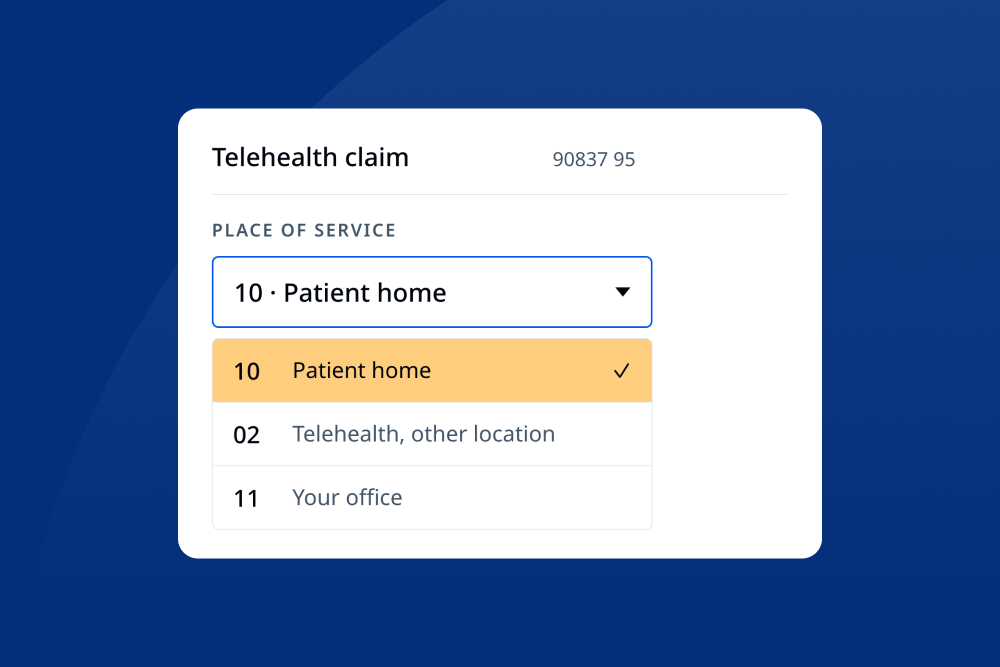
Place of service tells the plan where the session happened, and it changes reimbursement on many policies. The governing rule: place of service reflects where the client was located at the time of the session, not where you were. A clinician working from a home office still bills based on the client's location, not their own.
- 11 Office
- 10 Telehealth delivered to the client in their home
- 02 Telehealth delivered somewhere other than the client's home
Most payers want POS 02 or 10 for a telehealth session. The exception: Medicare and a number of commercial payers have, at various points since 2020, directed practices to bill telehealth psychotherapy under POS 11 with modifier 95, so the claim prices at the higher non-facility rate rather than the facility rate. Always confirm which convention a given payer wants before you set a default in your template, the same question that governs how a telehealth session gets billed on a filed claim. Following the general rule against a payer still on the POS 11 instruction gets that claim underpaid.
A code only pays by telehealth if it appears on that payer's covered telehealth list. Medicare keeps a list and revises it on a regular basis, while commercial payers maintain their own list.
Confirm a code is still covered before billing it by telehealth, even one you have billed that way before. This applies to the crisis codes 90839 and 90840, as much as it does to routine psychotherapy.
- Modifier 95 signals a synchronous audio-and-video telehealth session. Some plans still want it on every telehealth line, some ignore it, and a handful still ask for the older modifier GT instead.
- For audio-only sessions, use modifier 93. Some Medicaid and other state programs additionally require modifier FQ on audio-only claims.
- Where a modifier is required, it typically has to be repeated on add-on and secondary lines too, not only the primary code.
- A claim carrying 90785, 90833, 90836, 90838, or 90840 alongside a primary line generally needs the modifier on each line the payer requires it on.
A good rule of thumb is to ask the payer once and then be consistent..
Diagnosis codes are not optional
A superbill without a diagnosis is a receipt. Plans reimburse medical necessity and the ICD-10 code is how you assert it. Common examples include F41.1 for generalized anxiety disorder and F33.1 for recurrent major depressive disorder of moderate severity.
Z codes describing relational or life circumstances, on their own, are almost never reimbursable. This is worth telling clients before the first session, because a client who doesn't want a mental health diagnosis in their insurance record can’t use a superbill. That’s a legitimate choice, and it means they’re paying privately with no reimbursement.
How reimbursement works from the client's side
Clients will ask you to explain how reimbursements will work. Here’s the process they can expect:
- Client verifies benefits first. Before their session, the client calls the number on the back of their card and asks five things:
- Do I have out-of-network outpatient mental health benefits?
- What is my out-of-network deductible and how much have I met?
- What percentage do you reimburse after the deductible?
- Is reimbursement based on the billed amount or an allowed amount, and what is the deadline to file?
- The client pays you in full at each session.
- Client receives a superbill, usually monthly, covering all sessions in that period.
- Client submits it with the plan's out-of-network claim form.
- Then the client waits. An explanation of benefits typically arrives within two to six weeks, followed by a check or direct deposit.
The math is where expectations break
Walking a client through reimbursement numbers at the beginning can help prevent a lot of confusion later.
Here’s an example client scenarios:
Your fee is $180 per session., Your client has a $1,500 out-of-network deductible and their plan reimburses 60% after it’s met.
What your client hears: "60% of $180, so I will get $108 back.”
What the reality is: Their plan's allowed amount for 90834 is $130, which means your client will get $78 back (60% of $130).
That makes their true out of pocket cost $102 per session, which works out to roughly $2,077 out of pocket before any reimbursement begins in earnest.
What derails a superbill
- Missing NPI or tax ID
- A balance still showing as due
- No diagnosis, or a Z code alone
- Place of service that doesn't match how the session was delivered
- Filed past the plan's deadline, which can be anywhere from 90 days to a year
- Submitted without the plan's own claim form attached
- The plan simply has no out-of-network benefit, which is common with HMO and EPO products and most Medicaid managed care
- The client is a Medicaid beneficiary and you are enrolled as a Medicaid provider: an enrolled Medicaid provider generally cannot collect private payment from a Medicaid beneficiary for a covered service, and a superbill isn't a workaround for that restriction
Superbills and Medicare
Superbills generally don't work for Medicare beneficiaries. Depending on your enrollment status, claim submission may be mandatory, unless you may have opted out under a private contract. Neither one requires the beneficiary to submit a superbill for reimbursement.
Enrollment rules for behavioral health providers have moved recently (LPCs and MFTs became billable Medicare providers as of January 1, 2024), so confirm your current status with CMS or your Medicare Administrative Contractor (MAC) before promising anything.
Producing superbills without a spreadsheet
Building superbills by hand is a monthly admin task that can take up your evenings. Also, hand-entry is exactly where NPIs get transposed and dates get skipped. Your practice management software should assemble them from the session notes and payments already in the system. With TherapyAppointment, you can send a superbill directly to the client's portal with the click of a button, while also managing electronic claim filing, courtesy claims, and free ERA posting—all within the same system.
If most of your caseload is filing superbills and losing money to allowed amounts, it’s worth running the numbers on becoming an in-network provider.
CPT is a trademark of the American Medical Association, and CPT codes are copyright American Medical Association. Code descriptions above are written in our own words and are not the official descriptors. Allowed amounts, modifier requirements, filing deadlines, and documentation standards vary by payer, plan, and state. Verify with the specific plan.
Codes asserted: CPT 90791, CPT 90792, CPT 90832, CPT 90833, CPT 90834, CPT 90836, CPT 90837, CPT 90838, CPT 90846, CPT 90847, CPT 90853, CPT 90785, CPT 90839, CPT 90840, POS 11, POS 10, POS 02, Modifier 95, Modifier 93, Modifier GT, Modifier FQ, ICD-10 F41.1, ICD-10 F33.1