How to Bill a Telehealth Therapy Session: POS Codes & Modifiers
TherapyAppointment • Published on July 7, 2026
Key Takeaways
- Telehealth uses the same psychotherapy CPT codes as in person work. What changes is the place of service and the modifier.
- POS 10 is a client at home, POS 02 is a client anywhere else, and POS 11 is your office.
- The place of service describes where the client was, not where you were.
- Modifier 95 signals live audio and video and modifier 93 signals audio only. Some payers require one, others reject it as redundant.
- GT has been legacy on most professional claims since January 2017, though a few payers still ask for it.
- Your note needs the client's full address, your location, the modality, and consent.
Reviewed as of September 2026. Telehealth payment and coverage policy changes often; confirm details against current payer policy before relying on them.
Bill a telehealth therapy session with the same psychotherapy CPT codes you would use in the room. What changes is how you tell the payer where the client was and how the session reached them: the place of service code, and usually a telehealth modifier. Get those two fields right and the claim pays like an in-person session. Get them wrong and it denies, or worse, quietly underpays. They are listed below; for the time thresholds that separate 90834 from 90837, see 90834 vs 90837. This page covers the telehealth-specific mechanics on top of them.
What changes on a telehealth claim, and what does not
- Place of service. In your office you bill POS 11. On telehealth you bill POS 02 or POS 10, depending on where the client physically was, except with the payers noted below that instead want telehealth billed as POS 11 with a modifier. Verify which convention your payer wants before assuming the general rule applies.
- Modifier. Most payers want modifier 95 on a live video session. Some want 93 for audio only. A few still want the legacy GT.
- Documentation. Your note has to establish modality, both locations, and consent.
Everything else holds: the procedure code, the time thresholds, the diagnosis, the units, your fee. Telehealth is not a separate code family for psychotherapy. The client's cost share usually holds too, so their deductible, copay, and coinsurance apply as they would in office unless the plan carves telehealth out.
POS 02 vs POS 10: the difference is where the client sat
Both mean telehealth. They separate on one question: was the client at home?
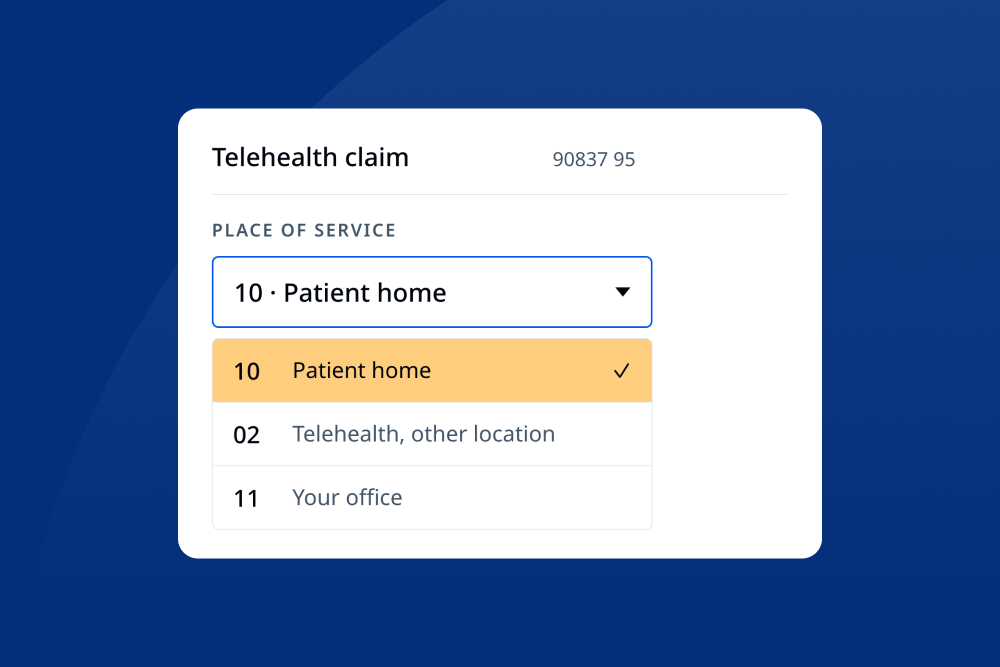
POS 10 is telehealth delivered to a client in their home. Home is read broadly: an apartment, a hotel room while traveling, a relative's house they are staying in.
POS 02 is telehealth delivered to a client who was somewhere other than home: their workplace, a parked car, a school, a residential program, another clinic site.
The hotel-room and parked-car examples above are this page's own reading of how "home" is generally applied, not a payer-published list. Payers can and do draw the line differently on edge cases, so verify before billing an unusual location rather than assuming our examples settle it.
Your location does not decide the POS. A common and expensive mistake is choosing 02 because the clinician was off site. The field describes the client's originating site, not yours.
POS 10 was added to the code set in 2022, though Medicare's claims-processing systems did not actually begin accepting it until April 1, 2022. Before that, everything telehealth went out as 02, which is why older billing guides and hand-me-down superbill templates still route home sessions to 02.
Why the POS choice moves your payment
Reviewed as of September 2026. Fee schedule amounts and mappings change annually; confirm current figures before quoting a dollar difference to anyone.
Most codes are priced two ways, a facility rate and a non-facility rate. Under the Medicare physician fee schedule, POS 02 has historically mapped to the facility rate and POS 10 to the non-facility rate, the higher of the two. The gap compounds fast across a caseload; the exact per-claim amount depends on the code, the year, and the locality, so check the current fee schedule rather than assuming a fixed figure.
Commercial payers copy this logic inconsistently, and the federal mapping has been adjusted more than once. Confirm current handling with each payer rather than assuming last year's answer still holds, especially if you are setting fees against expected reimbursement.
Modifier 95: real-time audio and video
Modifier 95 signals that the service was delivered over a live, two-way interactive connection carrying both audio and video. It attaches to the procedure code. A full-hour session with a client at home is 90837 with modifier 95, POS 10.
Whether you need it on top of the POS varies. Some payers treat the POS as sufficient and reject 95 as redundant. Other payers, including a number of commercial plans and state Medicaid programs, require it on every telehealth line. There is no safe universal default, so follow each payer's written policy.
Modifier 95 describes modality and nothing else. It does not establish coverage, licensure where the client sits, or consent.
Modifier 93 and audio-only sessions
Modifier 93 was added in 2022 for synchronous services delivered by audio only, no video. It covers a real-time phone session, not messaging or store-and-forward. Medicare has also used the HCPCS modifier FQ for audio-only behavioral health, and whether a payer wants 93, FQ, both, or neither is payer-specific.
Coverage of audio-only psychotherapy has moved repeatedly at the federal and state level since 2020, in both directions. Verify before the session, not after. A phone session you cannot bill is a phone session you gave away.
Is the GT modifier still used?
GT is largely legacy on professional claims. Once POS 02 was introduced to carry the telehealth signal, Medicare stopped requiring GT on professional claims filed on the CMS-1500 or its 837P equivalent, effective January 1, 2017, under that year's Physician Fee Schedule. Most of the industry followed. GT survives in institutional billing from certain facility types, and with a few payers whose claim edits were never updated.
Practical rule: default to the correct POS plus modifier 95, and use GT only when a payer's written policy asks for it. Sending GT to a payer expecting 95 usually produces a rejection, not a helpful correction.
You may also see GQ for asynchronous store-and-forward telecommunication, which rarely applies to psychotherapy, and FR for a supervising practitioner present by live video, which matters for supervision arrangements.
One more arrangement worth checking for: a handful of payers, including some regional and Medicaid plans, still want the telehealth session billed as POS 11 (as though it were in-office) with modifier 95 attached, rather than POS 02 or POS 10. It is uncommon, but common enough that it belongs on the same payer-verification checklist as GT.
The psychotherapy codes carry over unchanged
The code you would have billed in the room is the code you bill on video:
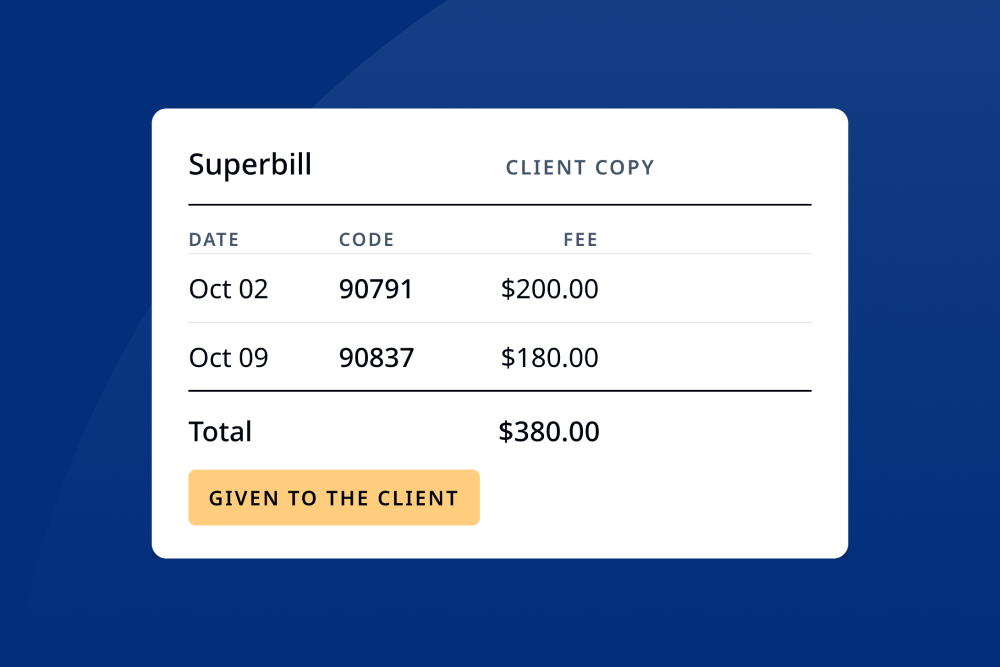
- 90791 the initial intake: gathering history, presenting concerns, and building a treatment plan, done by a non-prescribing clinician
- 90792 that same initial intake when a prescriber conducts it and folds in a medical evaluation
- 90832 psychotherapy at roughly 30 minutes (16 to 37 minutes of time spent with the client)
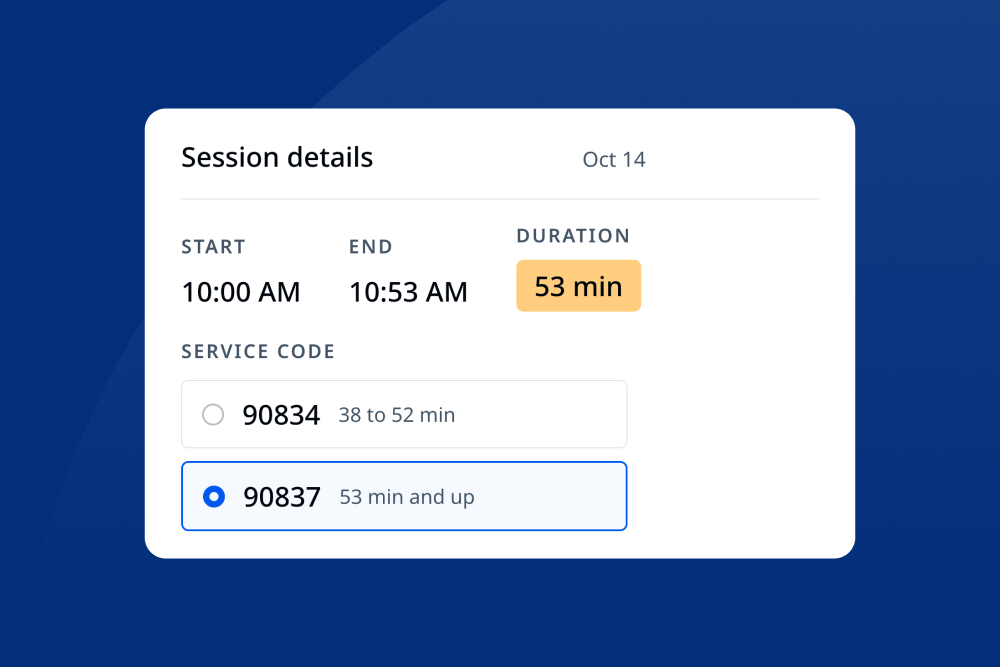
- 90834 psychotherapy at roughly 45 minutes (38 to 52 minutes)
- 90837 psychotherapy at 60 minutes or more (53 minutes and up)
- 90833, 90836, 90838 psychotherapy add-ons billed alongside an evaluation and management service by a prescriber
- 90846 a session with family or a partner focused on the client's treatment, held without the client in the room
- 90847 that same kind of family or couples session, held with the client also participating
- 90853 psychotherapy delivered to several clients together in one shared session
- 90839 crisis psychotherapy for a crisis contact involving roughly 30 to 74 minutes of time spent with the client
- 90840 each additional 30 minutes of that same crisis contact beyond 74 minutes (an add-on code, reported only alongside 90839 and never billed by itself)
- 90785 the interactive complexity add-on, when the criteria are genuinely met: reportable alongside 90791, 90792, 90832, 90834, 90837, and the 90833/90836/90838 add-ons, and with 90853; it is not reportable with 90846, 90847, 90839, or 90840
Time rules do not change for live audio-and-video sessions. A 50-minute video session sits in 90834 territory, and 53 minutes or more is 90837. Audio-only is a separate question: the clock runs the same on paper, but some payers cap the code below 90837 or will not pay 90837 at all for an audio-only contact, so confirm the payer's audio-only policy before billing a long phone-only session at the higher code.
90846 vs 90847 works the same on video: bill 90847 when the client joins the family session, and 90846 when you're meeting with family members on their own to support the client's treatment. Having participants on separate screens does not change the code. 90839 and 90840 are billable by telehealth under many policies (remember 90840 only ever rides alongside 90839), but a crisis session raises the documentation bar on safety planning. Record the client's exact address. If you need to send help, you will need it.
What your telehealth note has to establish
- The client's physical location during the session, as a full address, not "home"
- Your physical location
- The modality: live audio and video, or audio only and why
- That the client consented to telehealth, and when consent was obtained
- Everyone present on both ends of the call
- Start and stop times, or total minutes, for any time-based code
The address is the field people skip and regret. It sets your POS, it supports licensure (you are practicing where the client is sitting, not where you are), and it is the first thing an auditor asks for. The client's location also drives network participation and sometimes coverage itself, so confirm those before you schedule a session with a client who will be out of state. Use a HIPAA aligned video platform and name it.
Why telehealth claims deny or underpay
- POS 02 on a home session. Usually not a denial, just a smaller check, which is why it can run for months unnoticed.
- Modifier and POS mismatch. Modifier 95 sent to a payer that rejects it, or omitted for a payer that requires it.
- Audio-only billed as video. A session that dropped to phone and went out with 95 anyway.
- Licensure. The client traveled across a state line. The rules follow the client's location.
- Missing telehealth attestation. Some plans require separate telehealth enrollment before any telehealth claim will process.
- Modifiers dropped on the secondary claim. The primary pays cleanly and the secondary denies because the crossover lost the modifier. See our guide to billing secondary insurance claims.
- Modifier missing from an add-on line. Some payers require the telehealth modifier on every line of the claim, not just the primary procedure code (including add-ons like 90785, the 90833/90836/90838 psychotherapy add-ons, and 90840). Dropping it from the add-on line while the primary line is correct is a common, easy-to-miss denial cause.
Most of these are configuration problems, not judgment problems. If your EHR lets you attach place of service and telehealth modifiers to the appointment type itself, they carry onto the claim instead of depending on memory at the end of a long day. Check what your own EHR supports. TherapyAppointment’s billing and insurance tools include claim tracking and free ERA posting.
Verify these five things with each payer
Federal and state telehealth rules have changed repeatedly since 2020, sometimes with short notice and sometimes retroactively. Treat anything you read about current policy, this page included, as a starting point rather than a settled answer. The payer's own policy is the authority that gets the claim paid. This page was last reviewed in September 2026. Confirm nothing has shifted since.
- For a client at home, do you want POS 10 or POS 02, and is modifier 95 required or rejected?
- Is audio-only psychotherapy covered, and with modifier 93, FQ, or neither?
- Is there an in-person visit requirement attached to behavioral telehealth, and on what schedule?
- Are these codes paid at parity with in-office, and does the POS change the allowed amount?
- Do I need a separate telehealth attestation or enrollment on file?
On item 3: Medicare's in-person visit requirement for behavioral telehealth is unsettled. Congress has delayed and re-delayed it by statute multiple times since it was first enacted, and its status as of this review (September 2026) should not be assumed to be either permanently active or permanently waived; the deadline has moved before and can move again with little notice. Confirm its current status directly rather than relying on this page or last year's answer.
Get the answer in writing: the policy PDF, a portal screenshot, or at minimum a call reference number. Modifier rules are the kind of detail a phone rep gets wrong, and a reference number is what turns a wrong answer into a payable appeal. Credentialing is the right moment to ask all five, before you have a stack of held claims.
CPT is a registered trademark of the American Medical Association. CPT copyright American Medical Association. All rights reserved. The code descriptions above are plain-language summaries written in our own words, not official descriptors. Payer policies vary and change. This page is general billing education, not coding, legal, or reimbursement advice for your specific situation.
Codes asserted: 90791, 90792, 90832, 90833, 90834, 90836, 90837, 90838, 90839, 90840, 90846, 90847, 90853, 90785, POS 11, POS 02, POS 10, Modifier 95, Modifier 93, Modifier GT, Modifier GQ, Modifier FQ, Modifier FR
Crucial questions – addressed.
Do I use POS 02 or POS 10 for a client at home?
POS 10. It exists specifically for telehealth delivered to a client in their home. POS 02 is for telehealth delivered anywhere else, such as a workplace, school, or another facility. Your own location does not affect the choice, only the client's does.
Do I still need modifier 95 if I already used POS 10?
It depends on the payer. Some treat the place of service as sufficient and reject 95 as redundant. Other payers, including a number of commercial plans and state Medicaid programs, still require it on every telehealth line. Check each payer's written telehealth policy rather than applying one rule across your whole panel.
Is the GT modifier still valid?
Mostly not on professional claims. Medicare stopped requiring GT on CMS-1500 and 837P telehealth claims effective January 1, 2017 (the CY2017 Physician Fee Schedule), once POS 02 was introduced to carry that information. It persists in some institutional billing and with a few payers whose claim edits were never updated. Use it only when a payer asks for it in writing.
Can I bill 90837 for a telehealth session?
Yes, for a live audio-and-video session that meets the same time threshold you would apply in person: 53 minutes or more of psychotherapy. Telehealth does not change the time rules or create a separate code for video visits. Audio-only is less certain: some payers restrict or will not pay 90837 without video, so confirm the payer's audio-only policy before billing a long phone-only session at that code. Add the correct place of service and any modifier the payer requires.
What modifier do I use for a phone session with no video?
Modifier 93 identifies a synchronous audio-only service. Medicare has also used FQ for audio-only behavioral health. Coverage for audio-only psychotherapy varies by payer and by state and has changed repeatedly, so confirm coverage before the session rather than after.