90834 vs 90837: How to Choose the Right Psychotherapy Code
Headshot of Dr. Bill Whitehead
Dr. Bill Whitehead
Founder
a blue background with a keyboard and doctors stethescope

Key Takeaways

  • 90834 covers 38 to 52 minutes of psychotherapy. 90837 covers 53 minutes or longer.
  • The traditional 50 minute hour sits inside 90834, not 90837.
  • Only documented face to face time selects the code. Acuity and clinical preference do not.
  • Psychotherapy under 16 minutes is not separately reportable with these codes.
  • 90837 attracts utilization review because it pays roughly 25 to 35 percent more and is trivially auditable.
  • Record actual start and stop times. A duration copied from the appointment slot proves the slot length, not the session length.

Reviewed as of September 2026

Session length decides it. 90834 covers psychotherapy of 38 to 52 minutes. 90837 covers 53 minutes or longer. The standard 50 minute hour is 90834. Only documented face to face time determines the code, not acuity or clinical preference, though some payers require prior authorization for 90837.

That is the whole rule. Everything below is about the parts that trip people up: where the 53 minute line comes from, what counts toward the clock, why 90837 attracts records requests, and what documentation actually holds up.

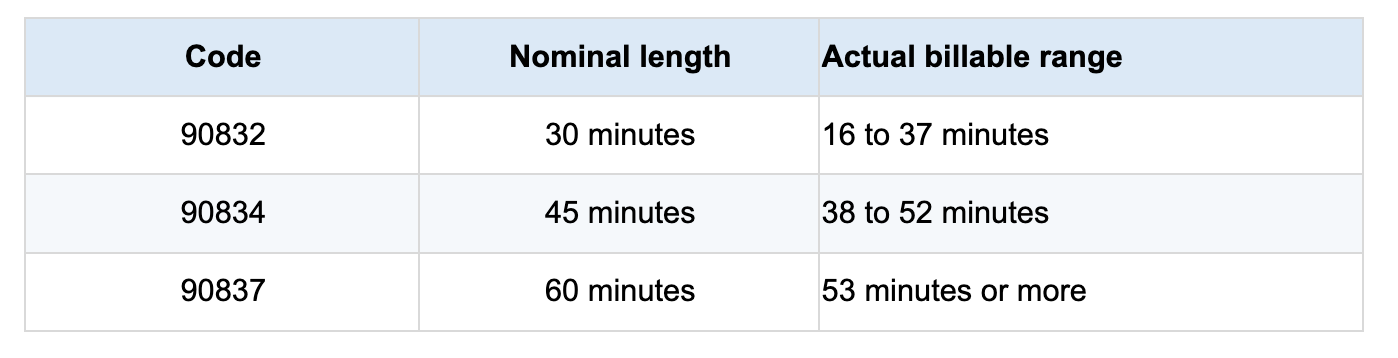
The time thresholds, in one table

CodeNominal lengthActual billable range
9083230 minutes16 to 37 minutes
9083445 minutes38 to 52 minutes
9083760 minutes53 minutes or more

Anything under 16 minutes of psychotherapy is not separately reportable with these codes. Anything over 60 minutes is still 90837. There is no add-on that pays you more for a 90 minute session in standard outpatient psychotherapy, which surprises clinicians running prolonged exposure or EMDR protocols designed around longer blocks. (The prolonged services codes that once covered this, 99354 and 99355, were deleted effective 2023; this is current policy, not a permanent feature of the code set.)

Where the 53 minute line comes from

Two different conventions are at work here, and they are easy to blur together.

The first is CPT's more than half rule for time based services: a timed unit becomes reportable once more than half of it has elapsed. That is what sets the floor at the bottom of this family. Half of the 30 minute 90832 is 15 minutes, so 16 minutes is the shortest psychotherapy you can report at all.

The second is what separates each code from the next one up. The 38 and 53 minute thresholds are midpoints between adjacent nominal session lengths, not applications of the more than half rule. Halfway between 30 and 45 is 37.5, which rounds up to the 38 minute start of 90834. Halfway between 45 and 60 is 52.5, which rounds up to the 53 minute start of 90837.

The arithmetic is worth knowing because it makes the numbers stick, but you never have to derive them. CPT publishes the time ranges for these codes directly, and those published ranges are what govern. The derivation only explains why they fall where they do.

This is why the traditional 50 minute hour lands squarely in 90834 territory. A clinician who has always called it "the therapy hour" and bills 90837 for it is, on the face of the record, coding above the documented time. That is a common source of recoupment letters in outpatient mental health.

What counts toward the clock, and what does not

Count face to face time with the client, including telehealth conducted in real time. That is it.

Do not count:

  • Writing the progress note, before or after
  • Reviewing the chart or preparing for the session
  • Time the client spent in the waiting room, including when they arrived early
  • Collecting payment or scheduling the next appointment
  • Phone calls to collateral contacts outside the session

If your client arrives 12 minutes late to a 60 minute slot and you work for 48 minutes, that is 90834. The slot length is irrelevant. What you bill is what happened.

A no show is a different situation, not a short session. If the client never arrives, there is no psychotherapy to time and nothing to report with these codes, however long you held the slot open.

Why 90837 draws scrutiny

Three reasons, and they compound.

It pays more. The spread between 90834 and 90837 typically runs 25 to 35 percent depending on payer and locality, so a shift in mix moves real money at the plan level.

Its use rose sharply after the psychotherapy code set was rebuilt in 2013, and payers noticed. Utilization review teams still look for clinicians whose panel is 90 or 100 percent 90837, because a uniform distribution suggests the code was chosen by habit rather than by clock.

It is trivially auditable. Unlike a diagnosis or a treatment plan, the only fact in dispute is a number. A reviewer opens the note, looks for start and stop times, and either finds them or does not. Carriers have repeatedly floated or piloted prior authorization requirements for 90837 over the years, and even where a given requirement gets walked back after clinician pushback, the underlying interest in the code never goes away.

Documentation that genuinely supports 90837

Keep the two jobs separate. Documented time is what selects the code, and nothing below changes that. Clinical rationale is what defends the choice if the claim is reviewed, by showing why the session genuinely ran as long as the record says.

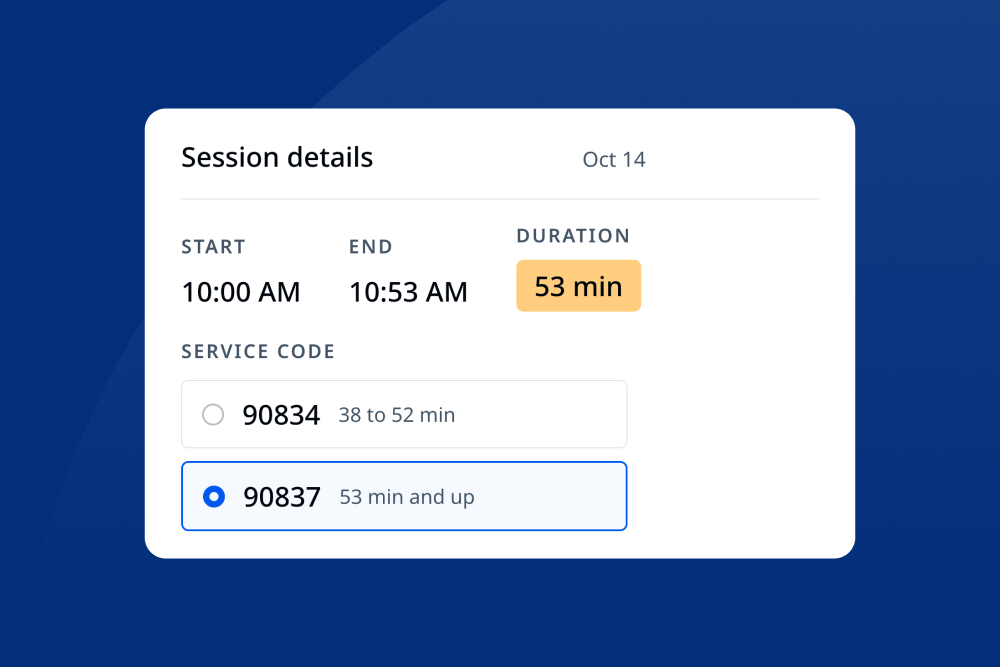
Recorded start and stop times in every note. Actual clock times, such as 2:04 pm to 3:01 pm, not a checkbox that says "60 min" and not a duration field the system fills in from the appointment slot. A duration copied from the calendar proves the slot length, not the session length.

A note whose content is proportionate to the time claimed. Four sentences attached to a 58 minute session is the pattern reviewers pull. Document what you actually did across the hour: the interventions used, the client's response, what shifted.

A clinical reason the work needs the longer format, tied to this client. Trauma processing that requires stabilization within the same session before the client can leave safely. Exposure and response prevention that needs habituation time to be therapeutic rather than sensitizing. High acuity presentations where risk assessment consumes part of every session. Dissociation that requires extended grounding.

A treatment plan that names the modality and its expected session length. If your plan says "prolonged exposure, weekly, 60 to 90 minutes," the longer format is already supported in the record before any single note is read.

Consistency over time. Occasional 90834 sessions in a caseload of 90837 sessions look like a clinician watching the clock. Nothing but 90837 looks like a default.

Prior authorization and payer variation

Be honest with yourself about this: policy differs by plan, not by carrier. The same insurance company may pay 90837 without comment on a commercial PPO, require authorization on its Medicaid managed care product, and limit frequency under an EAP arrangement. Some state Medicaid programs publish their own time definitions that do not match CPT exactly.

Check the behavioral health provider manual for the specific plan before you build a caseload of long sessions around it, and re-check at contract renewal. This is the same diligence that pays off in credentialing and in knowing your reimbursement rates generally.

The cost of coding scared

Undercoding out of fear is not the safe option, it is just a quieter loss. Take illustrative rates of $105 for 90834 and $138 for 90837, a $33 difference. A clinician seeing 25 sessions a week for 46 weeks, where half of those sessions genuinely run 53 minutes or longer, gives up roughly $19,000 a year by defaulting to 90834.

Overcoding costs more in a different currency. Billing 90837 for 50 minute sessions across a panel exposes you to recoupment, and depending on your payer contract, a reviewer may be able to extrapolate a sample error rate across your full claim history rather than recouping only the sessions actually reviewed. This is not a blanket power: Medicare, for example, may extrapolate only after specific statistical and procedural findings are met, not as a default in every audit.

The way out of both is not a rule of thumb, it is a clock. Record start and stop times, code what the record shows, and let the mix land where it lands. If your EHR stamps session start and stop times directly into the note, the documentation question largely answers itself. TherapyAppointment does this alongside claim filing and free ERA posting, so the time you bill and the time in the chart come from the same source.

Codes you will use alongside these

These are the closest neighbors of 90834 and 90837 in the psychotherapy code family:

  • 90832: the short session code, 16 to 37 minutes
  • 90791 and 90792: diagnostic evaluation, without and with medical services
  • 90846 and 90847: family therapy without the client present, and with the client present
  • 90853: group psychotherapy
  • 90839 and 90840: crisis psychotherapy, first 60 minutes and each additional 30 minutes
  • 90785: interactive complexity, an add-on for sessions complicated by factors such as third party involvement or communication barriers
  • 90833, 90836, 90838: psychotherapy add-ons reported with an evaluation and management service, for prescribers

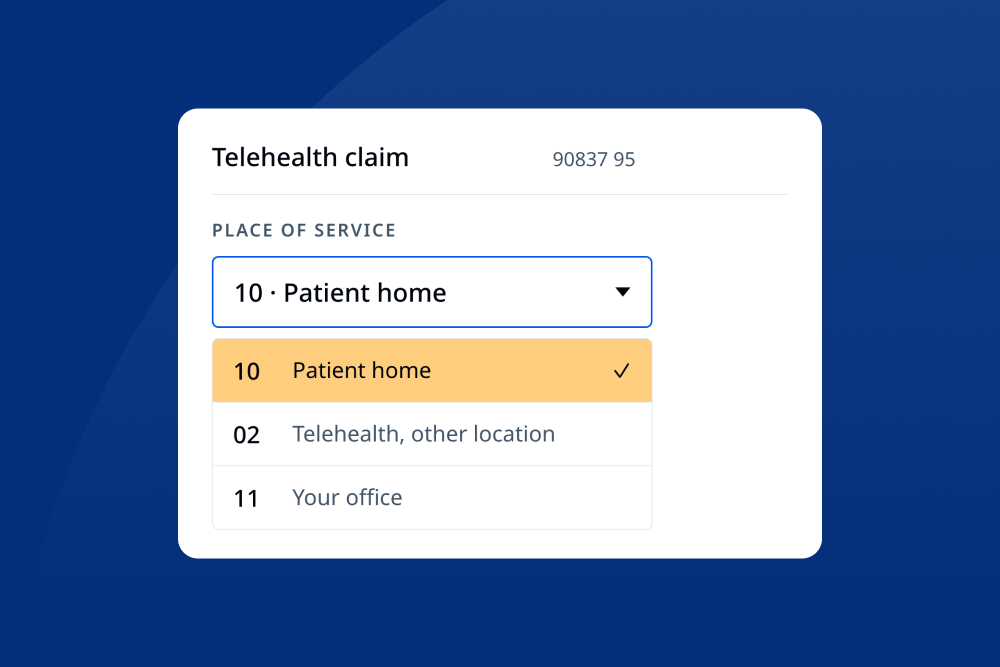
For telehealth, the code selection and time rules are identical to in person work. What changes is the place of service and modifier: POS 10 when the client is at home, POS 02 when they are elsewhere, POS 11 for in office, with modifier 95 required by many commercial payers. The place of service is not just a label: POS 02 pays the facility rate and POS 10 pays the non-facility rate, and those two rates are not the same number, so getting this wrong understates what a home session is worth. This POS and modifier guidance describes commercial payer practice. Medicare has its own overlay: mental health telehealth is covered only after an in-person visit with the client, subject to exceptions that Congress has periodically extended on a temporary basis, so confirm current Medicare telehealth rules separately before relying on this for a Medicare caseload. Policies here vary more than almost anything else in this article, so confirm per plan.

Once the claim goes out, the downstream mechanics matter too, especially when a second plan is involved or when the client is still working through a deductible.

CPT is a registered trademark of the American Medical Association. Descriptions here are written in plain language and are not official code descriptors. Payer policies vary, and this is general information rather than coding or legal advice.

Codes asserted: 90834, 90837, 90832, 90791, 90792, 90846, 90847, 90853, 90839, 90840, 90785, 90833, 90836, 90838, POS 10, POS 02, POS 11, Modifier 95

Crucial questions – addressed.

Is a 50 minute session 90834 or 90837?

90834. The 90837 threshold is 53 minutes of face to face time. A 50 minute session falls inside the 38 to 52 minute range for 90834, which is why the traditional therapy hour is a 90834 by default.

Does the clock include writing my progress note?

No. Only face to face time with the client counts, whether in person or by real time telehealth. Documentation, chart review, scheduling, payment collection, and calls to collateral contacts outside the session are all excluded.

Can I bill 90837 for every client on my caseload?

Only if every session genuinely runs 53 minutes or longer and your notes show it with start and stop times. A panel that is 100 percent 90837 is a common trigger for utilization review, so the record needs to carry the claim on its own.

What if a session runs 75 or 90 minutes?

Still 90837. There is no prolonged services add-on for standard outpatient psychotherapy (the codes that once covered this, 99354 and 99355, were deleted effective 2023), so a 90 minute session pays the same as a 55 minute one. Crisis codes are a separate pathway with their own criteria.

Does 90837 require prior authorization?

It depends on the specific plan, not the carrier name. Some Medicaid managed care plans and some behavioral health carve-outs require authorization or limit frequency, while many commercial plans do not. Check the behavioral health provider manual for each plan you are contracted with.