CPT Modifiers: A Plain-Language Guide for Therapists

Key Takeaways
If you are new to insurance billing, modifiers can feel like one more set of codes you are expected to understand. Fortunately, most mental health clinicians use only a few, and some practices rarely use any beyond those required for telehealth.
A modifier is a two-character code added to a CPT service code. It gives the insurance company extra information about how or under what circumstances the service was provided.
Think of it this way:
- The CPT code tells the payer what service you provided.
- The modifier adds an important detail about that service.
- The POS code tells the insurance the service location.
For example, 90834 identifies a psychotherapy service. If the session occurred through live video and the payer requires modifier 95, the claim may show 90834 with a POS 10 and a modifier of 95.
The modifier does not change the psychotherapy code, guarantee payment, or replace good documentation. It simply helps the payer process the claim correctly.
Important: Modifier requirements vary by payer, plan, provider type, state, and date of service. Never add a modifier simply because another clinician uses it. Check the client's benefits and the payer's current billing instructions.
What modifiers therapists see the most

These are not universal instructions. They are signals that help you recognize a modifier when it appears in a payer manual, clearinghouse message, or claim denial.
Telehealth modifiers: 95, 93, FQ, and GT
Telehealth is where private-practice therapists most commonly encounter modifiers.
Modifier 95: live video
Modifier 95 generally indicates that the clinician and client communicated through a real-time audio-and-video system.
Example:
A therapist provides a covered 45-minute psychotherapy session by live video. If the client's plan requires modifier 95, the claim may be submitted as 90834-95.
Do not assume every payer wants modifier 95. Some identify telehealth primarily through the place-of-service code, while others require both.
Modifier 93: audio-only
Modifier 93 generally identifies a live session conducted through audio-only technology, such as a telephone call.
Audio-only care is not automatically covered. Before providing it as a billable insurance service, confirm:
- The payer will cover the service by audio only.
- Your license and state rules allow it.
- The CPT code is eligible for audio-only delivery.
- You are using the modifier and place-of-service code the payer requires.
- Your note documents that the session was audio only and why that method was used when required.
Modifiers FQ and GT
You may also see FQ or GT in Medicare, Medicaid, facility, or commercial-payer instructions. Their use is more situation-specific than modifiers 95 and 93.
- FQ is associated with certain Medicare audio-only telehealth billing situations.
- GT is an older telehealth modifier that some payers and institutional claim types still require.
Do not use several telehealth modifiers “just in case.” Follow the instructions for the specific payer and claim type.
A modifier isn't a place-of-service code
This distinction causes a great deal of confusion.
- A modifier is attached to the CPT code and describes something about the service.
- A place-of-service code tells the payer where the service occurred for billing purposes.
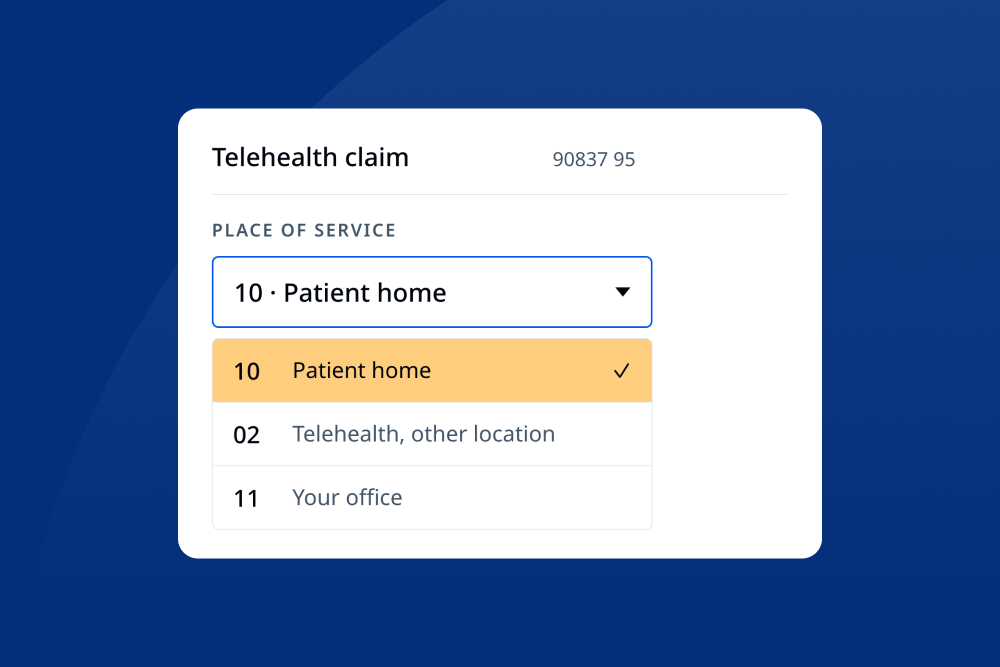
For telehealth, the place-of-service codes you are most likely to see are:
- POS 10: Telehealth provided while the client was in their home.
- POS 02: Telehealth provided while the client was somewhere other than their home.
A payer may require a telehealth place-of-service code, a modifier, both, or another arrangement. Always verify the payer's rules rather than treating one as a substitute for the other.
Modifier 59: separate doesn't mean “two services”
Modifier 59 indicates that one non-E/M service was distinct or independent from another service billed for the same client on the same date. It is frequently misunderstood and is not a routine solution for getting two same-day codes paid.
For a mental health clinician, the safest rule is:
Do not add modifier 59 solely because two services occurred on the same day or because the payer denied one of them.
The services must meet the payer's requirements for being separately reportable, and the record must clearly support the distinction. Depending on the circumstances, a more specific modifier may be required instead. Medicare instructs providers to use modifier 59 only when no more descriptive modifier fits.
Before using modifier 59, verify:
- The two codes are allowed to be reported together under the circumstances.
- The services were genuinely separate rather than overlapping or components of one another.
- The payer permits modifier 59 for that code combination.
- The documentation identifies the separate encounters, time periods, or other qualifying circumstances.
Because modifier 59 is closely reviewed and often misused, ask the payer or a qualified billing professional when you are uncertain.
Modifier 25: usually not a therapist modifier
Modifier 25 applies to a significant, separately identifiable evaluation and management (E/M) service performed by the same clinician on the same day as another procedure or service.
Most master's-level therapists do not bill E/M codes, so modifier 25 usually does not apply to their claims. It may be relevant to psychiatrists, psychiatric nurse practitioners, and other clinicians who are permitted to bill an E/M service and also provide another separately reportable service on the same date.
Modifier 25 does not mean “the appointment was complicated,” and it should not be added to a psychotherapy code merely because another service was also billed.
Modifier HJ: Employee Assistance Program services
Modifier HJ identifies an Employee Assistance Program, or EAP, service when required by the payer or EAP administrator.
If you accept EAP referrals, review the authorization carefully. It should tell you:
- Which sessions are authorized.
- Which CPT code to bill.
- Whether modifier HJ is required.
- Where to submit the claim or invoice.
- Whether the client may be charged for any portion of the visit.
EAP billing arrangements differ from one program to another, so the authorization is more reliable than a general modifier list.
Other modifiers therapists encounter
Depending on your license, setting, payer, and state Medicaid program, you may see additional modifiers identifying the clinician's credential level, the type of program, or another special circumstance. These requirements are especially common in Medicaid and managed-care billing.
Do not build a universal modifier list and apply it to every claim. Maintain payer-specific notes instead.
A simple workflow before submitting a claim
When you think a modifier may be needed, use this five-step check:
- Start with the service. Choose the CPT code supported by what you provided and documented.
- Identify the special circumstance. Was the session live video, audio only, an EAP visit, or a truly separate same-day service?
- Check the client's payer. Review the payer manual, provider portal, authorization, or written billing guidance.
- Confirm the whole claim. Check the modifier, place of service, provider type, and any authorization requirements together.
- Document consistently. The clinical note, appointment details, and claim should tell the same story.
If you call a payer, record the date, representative's name or reference number, and the instructions you received. That note can be valuable if the claim is later denied.
Common mistakes to avoid
- Automatically adding modifier 95 to every video claim without checking the payer.
- Billing an audio-only session without first confirming coverage.
- Confusing telehealth modifiers with place-of-service codes 02 and 10.
- Adding modifier 59 simply to override a denial or coding edit.
- Using modifier 25 when no separately billable E/M service occurred.
- Applying one payer's rules to every insurance plan.
- Failing to make the documentation match how the service was delivered.
The takeaway
You do not need to memorize every modifier to bill insurance successfully. You need to understand what a modifier does, recognize the few that commonly affect mental health claims, and verify the rules for the client's payer.
When in doubt, pause before submitting. A quick check of the payer's current guidance is usually easier than correcting a preventable denial.
Sources and editorial note
This article is general educational information, not legal, coding, or reimbursement advice. Payer policies and government program rules change. Confirm current requirements for each payer and date of service.
- CMS: Place of Service Code Set
- CMS: Proper Use of Modifiers 59, XE, XP, XS, and XU (April 2026)
- CMS: RHC and FQHC Distant-Site Telehealth Billing Update (May 2026)
- What is a CPT Code?